

#55 Home is an altar
can you honor who you are?
Before I flew home, I remember talking to my dad over the phone. The genocide was already ongoing months prior and I found myself reflecting on home, the meaning of home, and the power its significance holds for people very often. I have a home to return to, I tell my dad over the phone. I am lucky. I have somewhere to go. A lot of people nowadays don’t have such luck; a quick read through the news (or perhaps not the mainstream news, but those ran by organisations on Instagram) will tell you that much. I don’t like to think that my writing should be apolitical when our lives are dictated by politics; the fabric of our society is dictated by it, the opportunities we receive is shaped by it.
Without noticing, over the course of a few weeks, I accidentally build an altar.
The first few days of April were a flurry of activity. I woke up very early during the month of April, often checking my emails at 6 in the morning — Amsterdam’s noon — for updates and news about potential job opportunities. Maybe I won’t stick around for long and make it back to Amsterdam by mid May! I thought. Of course, as is usual with me, I tend to make decisions from some kind of other place and then they follow through exactly as they were decided. To be clear: I booked tickets for 8 weeks, a period covering April and May. And it was exactly the amount of time I remained here, thinking about the transitions of spring to summer, thinking about how I feel about family, thinking about how those of us who move countries tend to forget the altar in the effervescent excitement of becoming ourselves first.
Coincidentally, I graduated high school on a day like today nine years ago. I was 18 and in hindsight, more full of faith than I have ever been then or since. I decided to go to the Netherlands on a whim, after reviewing a few pages on a university website, thinking it sounded good and was taught in English, so why not give it a go. I wanted, more than anything, to develop a sense of self, far away from everything I knew and deep into the unknown. I moved to a city I had never visited. We had our first winters, our first snows. I found it such a sight! If you’re from a typically warm or tropical country, you know the wonder of it: everything blanketed in white, for a moment, sounds muffled across the street covered in particles of ice and snow. If you’ve moved away from home, you also remember spending days leading up to Christmas break working or studying or keeping busy, some of those Christmases on your own or with friends, some of them home, returning for the festivities and a million homemade meals. If you’re lucky, you get to come home. If you’re lucky, you still have a home to return to.
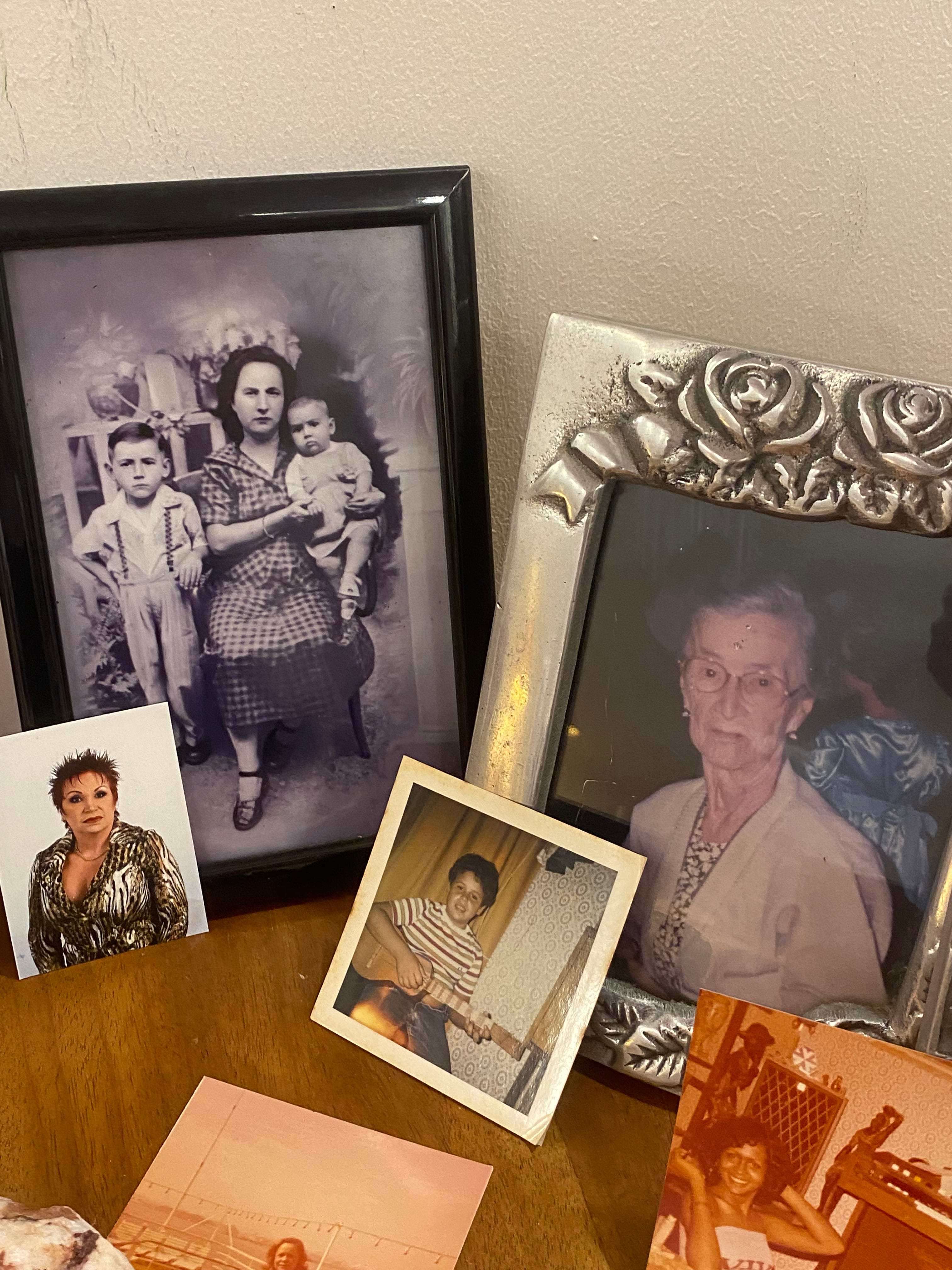
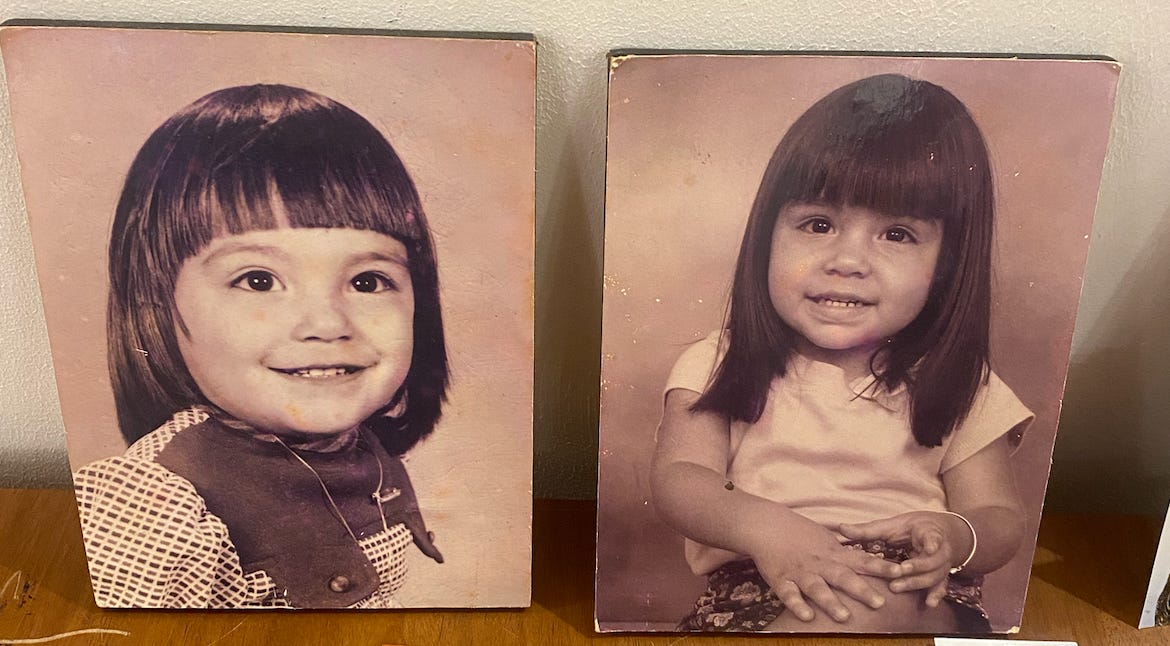
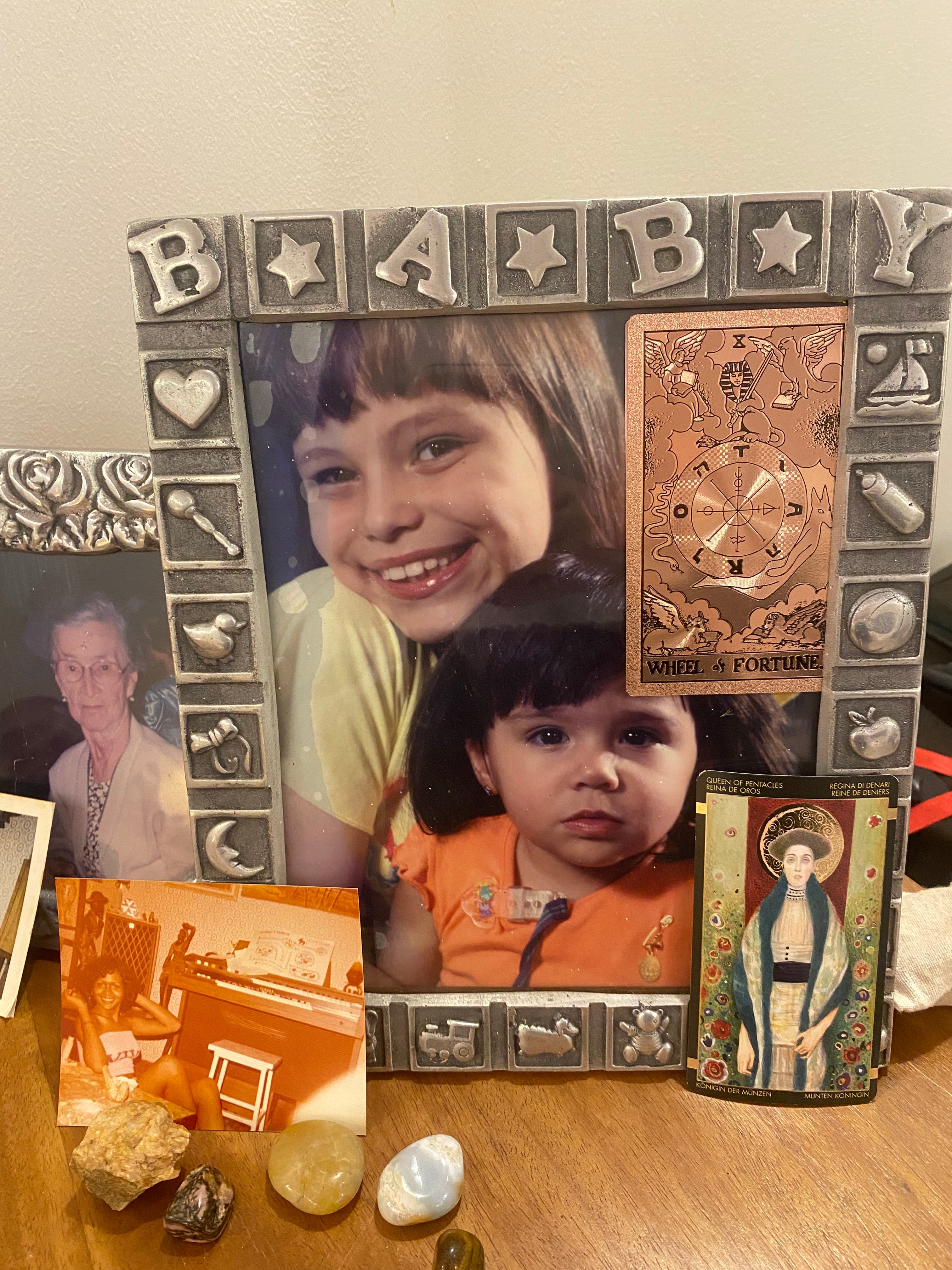
I build an altar over the course of a few days and then, after a few weeks, it’s complete. First, I find a photo of me and my sister, aged ten and three, in a silver frame. This photo comes alongside a two other frames: my paternal great-grandmother Rosa, another of her as a young mother, with my grandfather, standing next to her, and my great-aunt in her arms. Then I find two more photos: a side by side of my sister and mom at around the same age. Their similarity is uncanny. Black and white, looking into the camera but not quite, at something just a little above it, the same fringe, the same jet black straight hair framing their cheeks. The same nose, the same almond-shaped eyes. The same chin. They’re interchangeable, almost, except they’re decades apart.
I find more photos as the days progress, tucked away in photo albums from decades ago, faces and landscapes painted in sepia tones. They’re my paternal grandmother’s, having made their way here mysteriously and on my lap. They’ve been left in one of the hallways in my father’s house for years, and I find them while I keep digging for more images of my ancestry. I find my grandmother when she was young, a matching set in the 70s; my grandfather reading the newspaper; a rare surviving photograph of them together, maybe already in their 30s or early 40s. Photos of my aunt, who looks like a movie star, a cigarette hanging from her hand in a casual way, sometime in her early twenties. Before marriage, before children, before unspeakable loss. In this photo, she’s smiling ahead at the world and almost nothing has yet happened. Her whole life spreads far and wide before her. She has nothing to lose.
I find another photo of my uncle; he passed away at 26 and I never got to meet him. He looks eerily similar to my dad. He’s covering his face halfway, laughing, probably telling the person behind the camera to not come so close or to stop taking photos. But he’s good-natured, I can see it; he’s happy, I can feel it.

I combine all these photos on the dresser and add a few things I've brought from home: a couple of stones I’ve caught over the years at spiritual stores or gifted from friends, a rock gifted by my baby brother, two tarot cards signed by Caroline Calloway: the wheel of fortune and the queen of pentacles. I collect two big rocks in a terrain my dad is working on to build a small countryside house, pink and jagged and cream, one of them sparkling under the sun, lucid and marvelous. I lay down a photo of my dad in his first communion, another one of him by the piano, another one of him holding a guitar. I had never collected images of my family before. Not in the way I would display them in front of me, next to my door.
I wonder if moving away has some kind of delayed effect on touching back on your roots or whether it’s a decision you make once you get a little older. Migration at an early age is a little disconcerting because you’re so keen on becoming a person and being an individual and making all these choices for yourself, but you have no roadmap or idea of where to start, and it’s exciting, but it can also be disorienting. And yet I have a sneaky suspicion that this happens to everyone, whether they’ve moved away from home or not. I build an altar without knowing it for weeks at age 27 and I wonder how many more altars look exactly like this for other people. Do they also trace photos in sepia tones from when their grandparents were young? Do they trace the faces of their parents when they were teenagers, looking to the mirror to see what they inherited, and from whom?
I think they do.
Nowadays, the concept of home is under a lot of scrutiny. The idea of indigenous land, ownership, rights and allowances is on a lot of our minds. Who gets to call a place home? What ideology shaped it? Who gave who a claim to a home or to a land? All of it is imbued in politics; it is silly to not recognize that. My dad told a taxi driver today on our way home that the biggest battles happen on your knees. I have to agree with him. The biggest violence comes from a religion, if not religious, commitment to some kind of belief. Who lays a stake to land? Who has the right to demolish a home in the name of building their own? Should we allow it?
Home is a structure as much as it is ancestry. Developing a sense of self is necessary as much as it is to recognize the selves that birthed you. Growing in isolation — or what people call individuality, to me it’s become sort of the same thing, really — is one; not possible, because you’d have to live far from civilisation. Two — not real or true; if anything, it is deception. The difficulties generations before me faced have all been embedded into the person I am today. There is much to learn from their trials, their insecurities, their mistakes, their regrets. The times they lived in were vastly different and marked by struggles that I might not see as clearly today, except I have a gut feeling that every struggle is connected and multifaceted depending on what you can see.
So can you see beyond the deception that you’re only built on your self, your own ideas? Can you accept the truth — that you come from somewhere and there’s a root to you, beyond everything you’ve refashioned and changed and evolved over the years?
Can you look at it whole, unflinching, and learn where you’ve come from? And once you do, can you honor who you are? Can you honor who you’re yet to become?
